Patellar Tendinopathy: Heavy Slow Resistance for “Jumper’s Knee”
Have you heard that rest is the best cure for a sore knee, and that lifting heavy will only make it worse? That is the biggest myth about patellar tendinopathy, also called jumper’s knee. You may have heard it called tendinitis, which suggests the tendon is simply inflamed. But, that is not the full picture, either.
Tendinopathy is an umbrella term for a tendon that has become painful and can no longer handle its usual load, and its collagen fibres have often become disorganized. A tendon like that needs the right kind of load to rebuild, and heavy slow resistance is one promising way to do it.
This guide from Hartwell Therapy in Vancouver explains what is going on inside the tendon and how to get started.
What Is Patellar Tendinopathy?
The patellar tendon connects your kneecap to your shinbone. It passes along the force when you jump, run, climb stairs, or stand up from a squat.
Tendinopathy is an umbrella term for a painful tendon that can no longer tolerate the load it used to. You may also hear the older names tendinitis or tendinosis. In a healthy tendon, collagen fibres line up in neat, tight rows, like the strands in a rope. In tendinopathy, those rows become messy and disorganized, and the tendon handles load less well. Essentially, it becomes an overload problem, not a tear or “inflammation”.
It is common in sports with lots of jumping, such as basketball and volleyball, so it got the name jumper’s knee. It also affects runners, lifters, and weekend athletes. A season of beach volleyball at Kits Beach or a few too many trips up the Grouse Grind stairs can be enough to start it.
Common Signs of Jumper’s Knee
Typical signs include:
- pain at the front of the knee, just below the kneecap
- pain with jumping, running, stairs, squatting, or getting up from a low seat
- stiffness or soreness at the start of activity that may ease once you warm up
- tenderness when you press on the tendon just below the kneecap
- pain that flares the day after hard training
Three Myths About Jumper’s Knee
| Myth | What is closer to the truth |
| “I need to rest until the pain is gone.” | Rest, or smart load reduction, can calm pain. But if you stop completely, the tendon loses capacity, and the pain often returns when you restart. |
| “Heavy lifting will make my knee worse” | A tendon can adapt to heavy loads when they are added gradually, and the right dose is the key. Load stimulates collagen production. |
| “Pain during exercise means I am hurting my knee.” | Mild pain during rehab can be acceptable. Modern research suggests keeping pain at or below 3 out of 10 during exercises (Breda et al., 2021). |
What Is Heavy Slow Resistance?
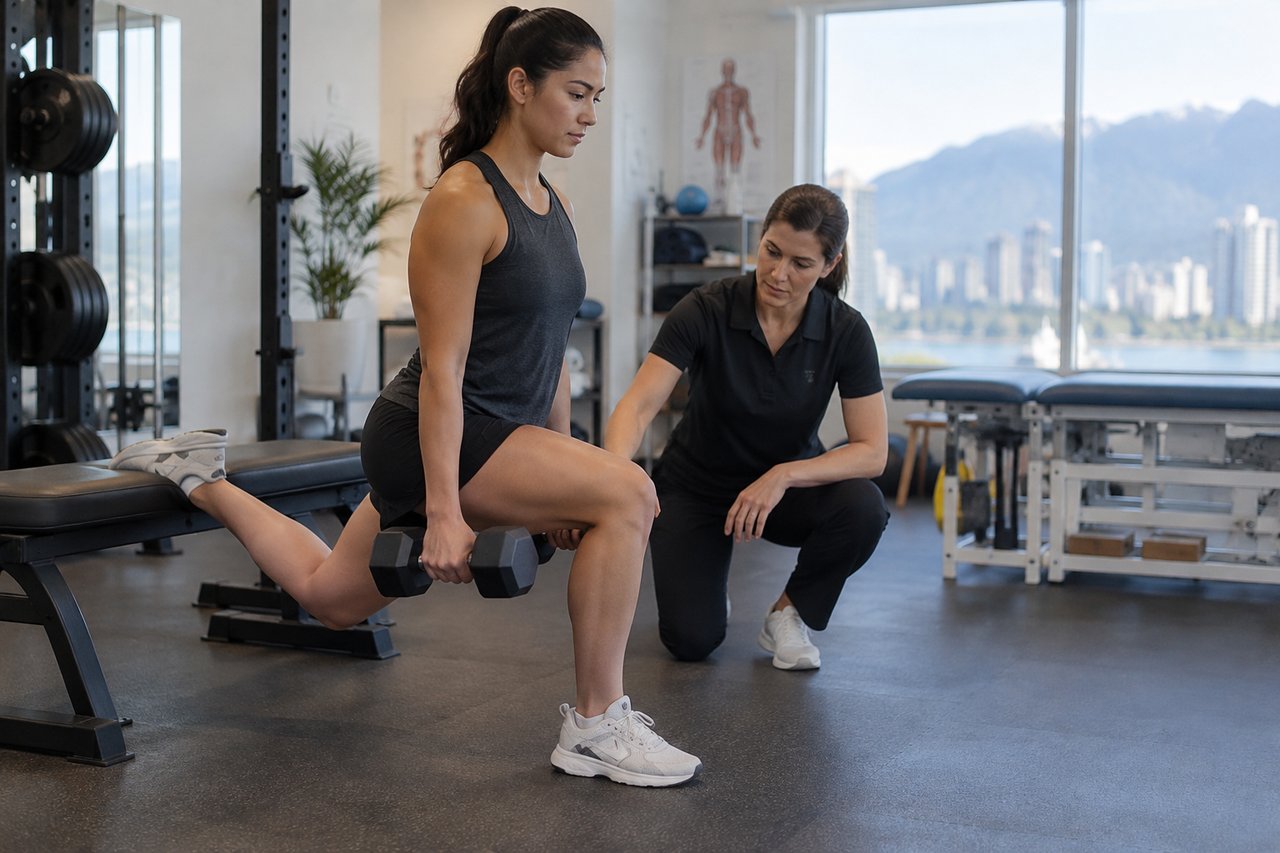
Heavy slow resistance (HSR) is a way of strengthening the tendon with weights that feel challenging, moved slowly and with control. Instead of quick, bouncy reps, you take about three seconds to lift and three seconds to lower. The slow pace keeps the load steady on the tendon, and the heavier weight signals it to adapt and become more capable over time.
The research is encouraging but still growing. A 2021 review of 37 randomized trials found that HSR looked at least as effective as eccentric exercise in the short and mid term.
A separate Dutch trial of 76 athletes compared a four-stage progressive loading program with decline squats, a common eccentric exercise. At 24 weeks, the progressive loading group had a greater improvement in function and had less pain during their exercises. Both groups improved, the programs were not supervised, and fewer than half of the progressive loading group had returned to their full sport by 24 weeks (Breda et al., 2021).
Progressive loading is not exactly the same as HSR, but both rely on the same idea: build the load up step by step.
A Phased Approach to Rehab
A good plan moves through stages. The timing depends on your pain, your history, and your sport.
| Phase | Goal | Example exercises |
| 1. Calm it down | Settle pain while keeping the tendon moving | Isometric holds, such as a wall sit or a leg extension hold, plus short walks |
| 2. Heavy slow resistance | Build strength and tendon capacity | Leg press, squat to a box, hack squat, split squat |
| 3. Energy storage | Teach the tendon to spring and absorb force | Skipping, pogo hops, light jump rope |
| 4. Return to sport | Get ready for your sport’s demands | Jumping, cutting, and sport drills in a planned order |
Isometric holds may give some quick pain relief for some people, but the evidence is low in strength and the long-term effects are unclear.
What an HSR Session Can Look Like
This is a general starting point, and a physiotherapist sets the right dose for you:
| Part of the plan | General starting point |
| How often | Two to three sessions a week, with a rest day between |
| Exercises | Two or three leg exercises, such as leg press, squats, or split squats |
| Sets and reps | Three to four sets of 6 to 15 reps, with the weight getting heavier as the reps get fewer |
| Tempo | About three seconds up and three seconds down |
| Pain | Aim for 3 out of 10 or less, and it should settle by the next day |
Support the Rest of the Leg
The knee does not work alone, so the plan should not either. Strong hips, glutes, and calves share the load with your patellar tendon when you jump and land. A good program includes them, along with practice landing softly and balancing on one leg.
Protecting Your Knee While You Load It
A few habits make a big difference:
- Avoid big jumps in jumping, running, or stair training, and add to your load a little at a time.
- Spread high-impact sessions across the week instead of stacking them back to back.
- Warm up with lighter sets before heavier work.
- Track your pain during and the next morning so you can adjust.
How Long Does It Take?
Tendons adapt slowly, so plan for months, not weeks. In the Dutch trial, about half of the athletes in each group had a meaningful improvement by 12 weeks, and by 24 weeks about 8 in 10 had (Breda et al., 2021). Pain can improve before the tendon is ready for full sport, so patience matters. Going back too soon is a common reason jumper’s knee returns.
When to See a Physiotherapist or Doctor
Consider booking an assessment if you notice:
- knee pain that is not settling after a few weeks of changing your activity
- pain that limits jumping, stairs, or sport
- pain that keeps returning each time you go back to training
- pain at rest or at night
Get medical care promptly for a sudden sharp pain with a pop, trouble straightening your leg, or a hot, red, swollen knee, especially with a fever.
Find a Plan That Fits Your Knee
You do not have to give up the sports you love. You need a plan that matches your tendon’s capacity to the demands you put on it. At Hartwell Therapy in Vancouver, with locations on Main Street, Ontario Street, and Victoria Drive, we offer physiotherapy assessments and exercise rehab, including kinesiology and active rehab. We will look at how you jump, run, and lift, build a loading plan step by step, and adjust it as your knee responds. Reach out to book an assessment whenever you are ready.
References
Breda, S. J., Oei, E. H. G., Zwerver, J., Visser, E., Waarsing, E., Krestin, G. P., & de Vos, R.-J. (2021). Effectiveness of progressive tendon-loading exercise therapy in patients with patellar tendinopathy: A randomised clinical trial. British Journal of Sports Medicine, 55(9), 501-509. https://bjsm.bmj.com/content/55/9/501
Challoumas, D., Pedret, C., Biddle, M., Ng, N. Y. B., Kirwan, P., Cooper, B., Nicholas, P., Wilson, S., Clifford, C., & Millar, N. L. (2021). Management of patellar tendinopathy: A systematic review and network meta-analysis of randomised studies. BMJ Open Sport & Exercise Medicine, 7(4), Article e001110. https://bmjopensem.bmj.com/content/7/4/e001110